lyearn • shipped • 2026
Rearchitecting
org
setup
to
work
at
scale
Turning Lyearn's rigid, one-dimensional org model into a flexible system that mirrors how companies are actually structured, and making setup something teams could finish in days instead of weeks.
my role
Product Designer. Owned research, end-to-end design and finalised the new architecture concept (detailed out by backend lead).
team
1 Produce Designer (Me), 1 Design Lead, 2 Engineers
type
Full-Time
duration
3 Weeks
the problem
Lyearn modelled every org as one rigid shape, and most companies couldn't fit into it.
Lyearn modelled an org as a single linear chain: Departments → Tracks → Roles → Employees. It worked for simple teams, but real companies vary in depth and shape, and the chain couldn't bend to fit them.
1
Fixed depth
Smaller teams were able to fit into the old fixed hierarchy. A larger org needed an extra level and there was no way to add it.
2
Inconsistent Duplicate Job Profiles
A role like "Senior Product Designer" sat inside one track, inside one department. If two teams needed the same role, they had to duplicate it, and every duplicate was an inconsistency.
"We had the same job profiles across three regions. Duplicating them meant every update was three updates, and they always drifted out of sync."
ops / it manager, user interviews
research
Most HR platforms keep org hierarchy and job architecture separate.
I looked at how other platforms handle this. Workday was the benchmark for large, multinational orgs, and newer tools like HiBob and BambooHR for smaller, SMB-focused companies.
1
Legacy Platforms are Rigid
Platforms like Workday have rigid structures and need a lot of manual setup, but the data stays clean at scale, which is what large orgs need most.
2
Modern Platforms are flexible
Platforms like HiBob and BambooHR offer more flexibility in hierarchy depth and how structured job profiles are, built for SMBs who move quickly.
"We're a fairly flat company with a couple of unusual reporting lines, and every tool wants us to pretend we're a neat pyramid. We're just not."
hr lead, user interviews
brainstorming
I dumped ideas, good or bad, shortlisted three, and took one forward to implement
I brainstormed many fixes that could potentially address the issues. I then evaluated each of them and rated their scalability and stability with stakeholders.
chosen solution
Ditched the combined structure and split it into three
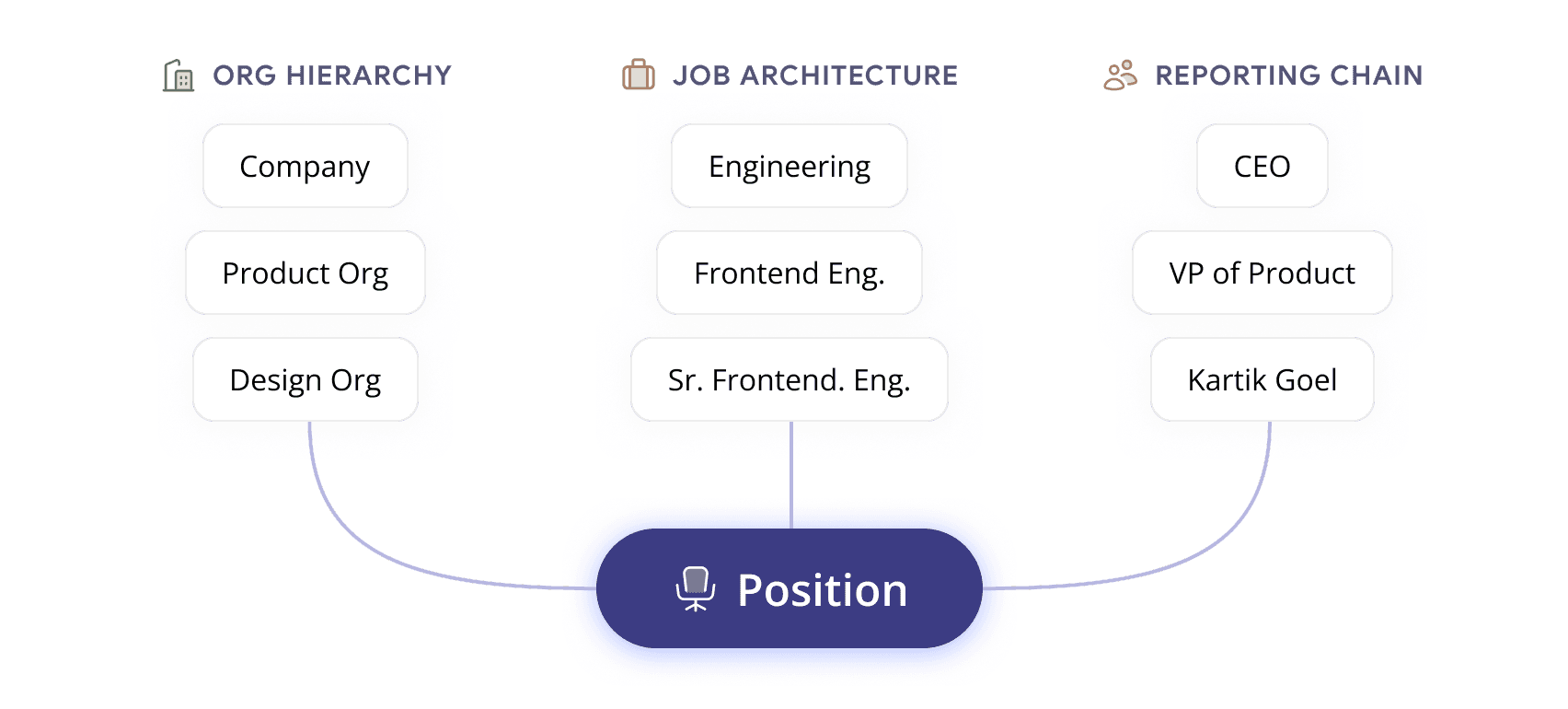
Instead of one chain doing three jobs, I built three independent structures and connected them with a single container called “Position”.
Org hierarchy
Companies can nest orgs indefinitely. We don't define what an "org" is. It could be a department, a product vertical, or a location.
Job architecture
Its own three-level hierarchy. Job family groups, Job families, Job profiles, which no longer live inside orgs.
Reporting
Every employee has a "Reports to" field, which builds a chain up to the C-suite, separate from where they sit in the org.
introducing positions
A Position is a seat that ties the three structures
A Position is a seat inside an org. A job profile is applied to it, and an employee is assigned to it. The employee gets their responsibilities from the profile on their seat. That lets the three structures stay separate but still connected.
1
Reuse without duplication
One job profile applied across many orgs. Update it once and every seat updates.
2
Vacant Positions
A seat can sit empty when someone leaves — a real, represented vacancy. The old model couldn't show this at all.
3

Headcount Planning
A position can hold more than one seat — the starting point for headcount planning, and for Recruitment and Payroll next.
"This fixes what we'd worked around for years. We used to track open roles in a separate sheet, and that defeated the point of having a full-on system."
ops / it manager, usability testing
org tree
Visualising the org tree
For the org tree, the goal was to visualise the real architecture transparently. People didn’t live inside orgs, they occupied the positions inside the orgs, and the row order reflected that.
removing the unawareness
I displayed everything users needed to know on an "intro to org set-up" page
The old setup dropped people straight into a CSV upload, and only then told them it needed a strict template. A lot of them gave up right there. The new intro page sets expectations upfront.
A glimpse of the 3 structures
Required fields communicated before starting the flow
impact
Setup got faster and support tickets dropped
59% less time for CSV set-up
From avg. 2 weeks to 5.6 days. Tracked from arriving on set-up page to import completion state.
75% less support tickets
Avg. 28/month to 7/month. Tracked over 2 months, ongoing.
80% less time for integration set-up
Avg. 5 hours to ~1 hour. Tracked from arriving on set-up page to integration completed state.
Thank you for reading!
more projects
